Go-to-market
This article explains the discipline of Revenue Stream Management and how to get started. It is relevant for CCO's working with GTM strategy and execution.
A discipline for Go-To-Market
Revenue Stream Management (RSM) is a discipline or approach for Go-To-Market (GTM), that ensures strong alignment between the customer/market - and then our commercial functions for instance Marketing, Prospecting, Sales, Customer Success and Delivery. The purpose of RSM is to connect all functions involved in the company’s commercial activities, ensuring they work in coordination with each other and in-line with the overall company strategy. By doing so, it promotes a shared commercial mindset across the organization. In essence, Revenue Stream Management provides the operational structure needed to translate commercial strategy into focused and effective execution across the entire GTM organisation.
Focus on Revenue Streams rather than departments
In Revenue Stream Management the focus is on managing Revenue Streams, rather than individual departments and Silo-based KPIs. A Revenue Stream represents how a specific group of customers perceives the value delivered through a defined set of our products and services. It captures the commercial ideas and perspectives that resonate with both prospects and existing customers.
Internally, a Revenue Stream serves as an alignment engine across the entire GTM teams interacting with customers. It ensures that value is communicated consistently while keeping the organization closely aligned. Everyone knows exactly how they contribute to the Revenue Stream and which tasks to prioritise. 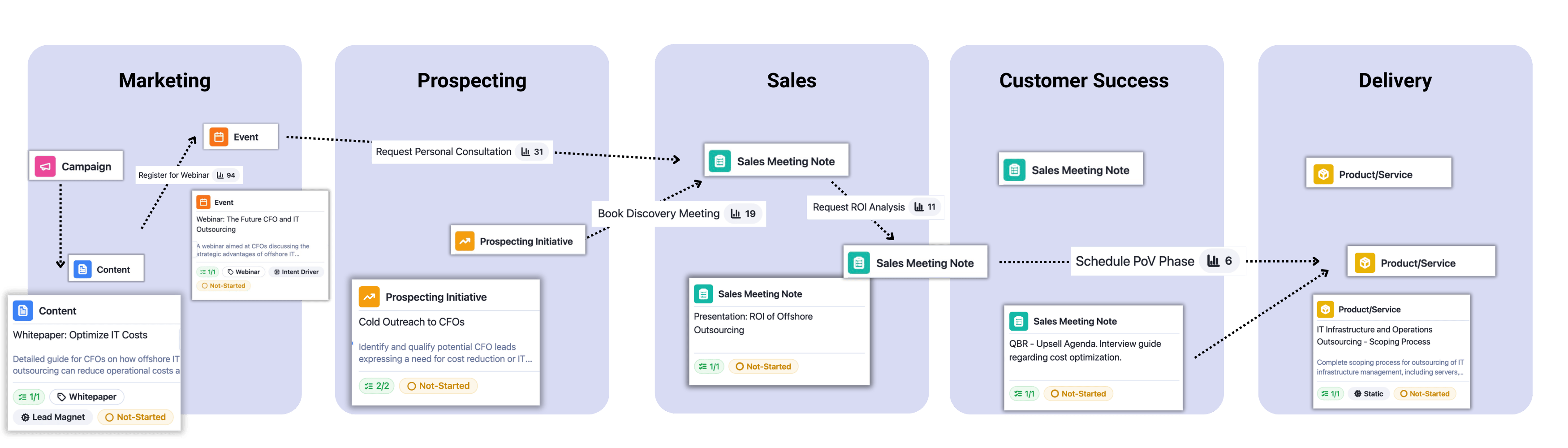
How to design a Revenue Stream
A well-designed Revenue Stream ensures a coherent customer experience across all business functions throughout the customer journey. It delivers consistent, highly relevant messaging tailored to specific customer segments and personas, creating a clear “universe” that helps customers understand the value they receive - or expect to receive.
A Revenue Stream consists of some key elements, that need to be in place for successful execution: The Foundation, GTM and Engagement Assets, the intended customer motion (CTA) and the Work Items.
1. The Foundation
The first thing to do when designing and architecting a Revenue Stream is defining and describing the Foundation. The Foundation assets is about defining crystal-clear personas, segments, and commercial narratives.
- Segments & Personas: Who exactly are we targeting? (e.g., CEOs in Innovation-seeking SMEs in Manufacturing).
- Commercial Narratives: What is the specific value proposition that resonates with those personas, and how do we express in a language that they recognize?
- Channels: Where do these people look for information?
- Social proof: Do we have testimonials and reference case studies we can leverage for the messaging?
The Foundation eliminates the 'Handover Gap.' It ensures that your GTM (Go-To-Market) engine isn't just fast - it’s heading in the right direction. This is the "Single Source of Truth" that aligns your entire organization.

2. The GTM and Engagement Assets
The next thing to do when designing a revenue stream is the GTM & Engagement design: the process of selecting and building the specific activities (content, campaigns, call-scripts, sales meeting preparation, etc) needed for the Revenue Stream. The GTM & Engagement Assets is the bridge between your strategy and your revenue. If the Foundation defines who you are talking to and what you are saying, the GTM & Engagement Assets are the actual activities and preparation that brings it to market. They are the elements of the customer universe you are providing to the customer within the Revenue Stream context - all the way from first contact to final delivery.
What to consider in relation to GTM and Engagement Assets:
- GTM & Engagement design: the process of selecting and building the specific activities (content, campaigns, call-scripts, sales meeting preparation, etc) needed for the Revenue Stream.
Call-To-Actions: Decide on the intended/expected outcome and interconnects of those activities/assets. Ensuring customer interest is maintained and nutured.
Operational Alignment: Make sure you have an overview of every stage of the buying journey from Marketing and Prospecting to Sales and Delivery. So everyone in the GTM organization knows the exact purpose and intend of each GTM and Engagement Asset.
Every asset must have a defined function. In Revenue Stream Management, assets are categorize not by their format (PDF, Video, Email), but by their strategic intent:
-
Branding: Creating recognition and trust
-
Lead Magnets: Trading high-value insights for contact information
-
Intent drivers: Identifying prospects who are ready to solve their problems now - willing to make a purchase.

3. The intended customer motion (Call-to-action)
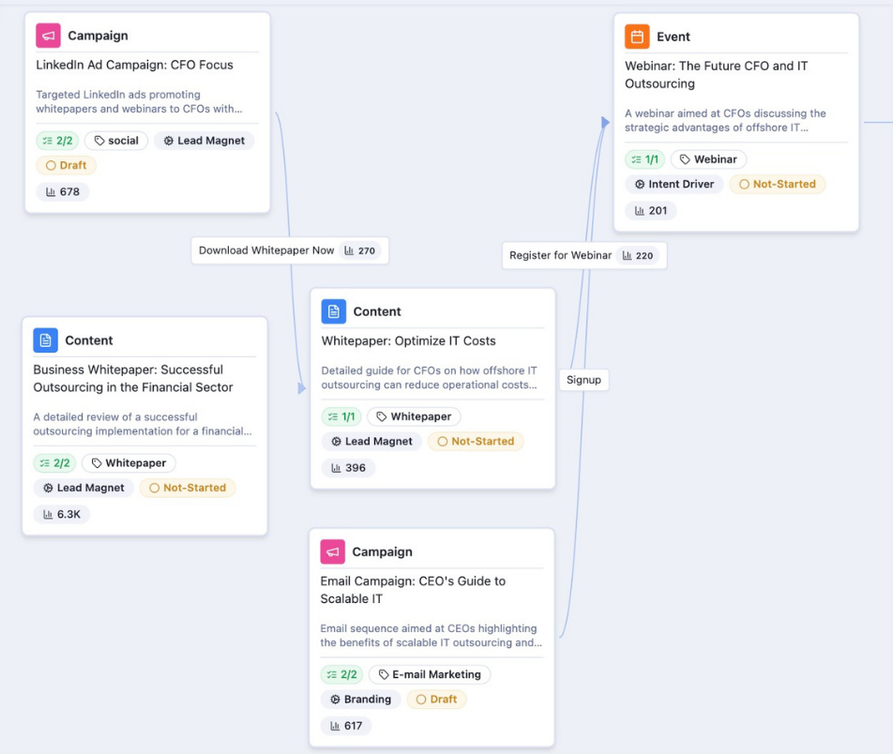
In Revenue Stream Management Call-to-Action Relationships are the "nervous system" of the Go-to-Market machine.
While most GTM Strategies struggle to show cohesion and looks at assets as individual "silos" (a separate blog, a separate webinar, a separate sales deck), Revenue Stream Management focuses on the links between them. A CTA is expressing our expected intent of the customer, which is key to move customer interest forward. So when designing a Revenue Stream it's important to clearly link all assets with CTA to drive customers further in the revenue stream - all the way from marketing to delivery.
4. Work items - Tasks with a clear purpose
Work items are the actual work that needs to be done in order to finalize a Revenue Stream and move from design to market ready. Eg. design a solution package, write a landing page, book an exhibition booth, call new prospect, prepare a personal demo, facilitate a workshop etc.
Each work item must be related to a specific Revenue Stream and Asset. Without an asset a Work Item is just a random task (e.g., "Write 500 words"). This makes it easy for the entire GTM team and management to understand how each individual work supports the overall strategic goals and which tasks to prioritise.
To sum it up
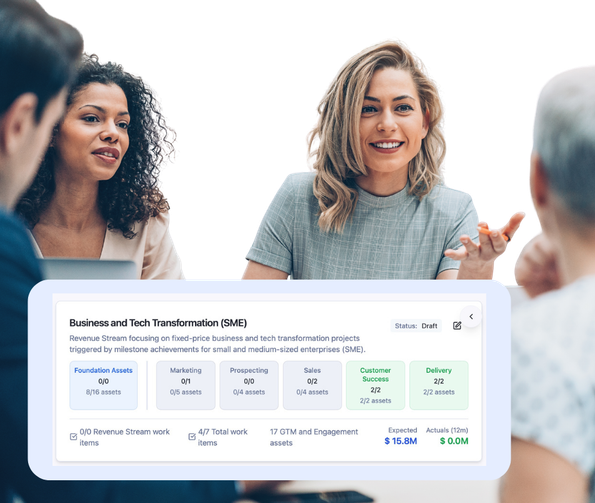
Revenue Stream Management is a discipline for Go-To-Market, where the focus is on managing revenue streams, rather than individual departments and KPI's. A Revenue Stream is defined by the value that the customer perceives to extract from the company deliveries. The main idea in revenue stream management is that the value perceived from a customer perspective can be very different from each customer to customer depending on their point of view. The revenue stream management process aims to ensure that we as a company understand those differences in the multiple customer perspectives and meet those perspectives with a coherent an aligned understanding all the way from initial contact to final delivery.
How to get started with Revenue Stream Management?
BIGR AI Platform is the first platform built specifically for Revenue Stream management.
It is designed to support the Revenue Stream management process and build revenue streams across your entire GTM organisation.
Learn more about BIGR Platform: